
10
May
German baking culture is celebrated for its precision, tradition, and respect for high-quality ingredients. From cozy family kitchens to artisanal bakeries in Munich and Berlin, baking in Germany combines creativity with scientific exactness. As a result, every loaf and cake maintains consistent texture and flavor, whether baked in a home oven or a professional deck oven.
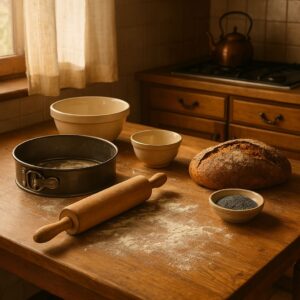
A welcoming scene of traditional German baking tools, evoking a sense of heritage and craftsmanship.
Origins and Significance of German Baking
In Germany, baking is more than a hobby—it is a cultural cornerstone. Historically, medieval guilds established strict rules for bakers, ensuring quality and fairness. Over centuries, these regulations evolved into regional specialties that still thrive today. Consequently, rye breads in Northern Germany, sweet Bavarian pretzels (Laugenbrezeln), and nut-studded loaves in the Southwest each reflect local customs and ingredients.
Moreover, baking unites families and communities. For instance, private households often gather on weekends to prepare festive Stollen during Advent, while local cafés fill their counters with fresh pastries every morning. Ultimately, this dual presence in homes and businesses underscores baking’s social role.
Why Precision Matters
Firstly, precision guarantees consistency. Exact ingredient weights prevent soggy cakes or overly dense breads. Secondly, it preserves tradition: following time-honored methods keeps authentic flavors alive. Furthermore, standardization optimizes efficiency, reducing waste and streamlining production.
Thus, German baking tools and measurements play a crucial role in maintaining these high standards.
Essential Baking Tools and Ingredients
3.1 Baking Pans (Backformen)
Consequently, choosing the right pan material—often heavy-gauge aluminum—ensures even heat distribution and reliable results.
3.2 Kitchen Scales (Küchenwaagen)
Rather than relying on cups, German bakers weigh ingredients in grams (g) and ounces (oz). For example, measuring exactly 200 g (7 oz) of flour ensures uniform dough consistency every single time.
3.3 Leavening Agents: Baking Powder vs. Yeast
German recipes specify which to use, along with precise proofing times and temperatures.
3.4 Specialty Ingredient: Vanilla Sugar (Vanillinzucker)
Vanillinzucker is sugar infused with real vanilla pods. Most recipes call for one packet (8 g / 0.28 oz) to add subtle vanilla aroma without extra liquid. Alternatively, synthetic Vanillin sugar is also available and widely used, offering a more affordable but less nuanced option.
Appreciating Baking Traditions
Traditionally, festivals such as Christmas markets and St. Martin’s Day showcase seasonal baked specialties: spiced Lebkuchen, glazed gingerbread hearts, and rich Christmas Stollen. Consequently, these events foster community spirit and connect generations through shared recipes.
Simone from Bavaria remembers her grandmother’s kitchen every December: the warm scent of cinnamon, the neatly lined tins of vanillinzucker, and the friendly competition among neighborhood children to decorate the best cookie. Without a doubt, these moments demonstrate how baking cultivates creativity and connection.
Practical Baking Tips
A Simple Life Hack for Perfect Results
Humidity Hack: To keep your dough moist during proofing, place a shallow pan of hot water at the bottom of your oven or proofing area. This simple trick creates a humid environment, preventing the crust from drying out and ensuring a soft, even rise.
Ingredients
Steps
Why Baking in Grams Changes Everything
Transitioning to grams eliminates guesswork. Since one gram can shift dough hydration, gram-based measures guarantee repeatable results. Additionally, scaling recipes becomes straightforward—just multiply or divide each ingredient by the same factor.
Final Thoughts and Key Takeaways
To sum up, German baking culture thrives on precision, tradition, and community. By using specialized tools, exact measurements, and time-honored ingredients like vanillinzucker, you can replicate authentic German flavors in your own kitchen. Thus, whether you are an experienced chef or home baker, embracing these methods will elevate your baking and deepen your appreciation for this rich heritage.
German baking emphasizes precision. Using grams ensures more accurate measurements compared to cups, especially for dry ingredients. This leads to consistent baking results every time.
Vanillinzucker, or vanilla sugar, is a common baking ingredient in Germany. It’s typically a blend of granulated sugar and real vanilla, used to add natural aroma and flavor to baked goods.
Baking powder is a chemical leavening agent that works quickly and is used in cakes and cookies. Yeast is a biological agent used for doughs like bread and rolls, requiring time to rise and ferment.
Many traditional German recipes have been passed down unchanged for generations. Accuracy in ingredients and method preserves authenticity and ensures perfect results.

