
11
Apr
In Germany, yeast is one of those ingredients that seems simple until you actually need to buy it, translate it, or use it in a recipe from another country. A baker may open a German package labeled Hefe, a recipe may call for Trockenhefe, and an American cookbook may ask for instant yeast or active dry yeast. At first glance, these terms can feel interchangeable. In practice, they are related but not identical, and understanding the difference makes baking in Germany much easier.
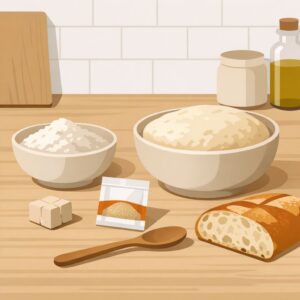
Fresh yeast, dry yeast, and instant yeast are essential ingredients in German baking traditions.
Yeast matters in Germany because baking matters in Germany. Bread, rolls, sweet buns, cakes, and holiday pastries are part of everyday life, not just special occasions. A German breakfast table often depends on bread or rolls, a Sunday cake may rely on a well-risen dough, and many traditional recipes are built around the quiet work of fermentation. Yeast is the small ingredient that makes all of that possible.
Fresh yeast is the traditional form and one of the most familiar options in German baking. It is usually sold in small cubes and has a short shelf life, which means it must be used relatively quickly. Many German bakers still value it highly because it performs reliably in classic doughs and has long been associated with traditional recipes.
Fresh yeast is often the first choice for people who bake regularly and want a product that behaves in a familiar, predictable way. It is especially common in recipes that come from older German baking traditions, where the method assumes fresh yeast from the start.
Dry yeast is the practical pantry version. It keeps longer, stores more easily, and is convenient for people who do not bake every day. In Germany, dry yeast is widely available and commonly used in home kitchens. It is the version many people keep on hand for spontaneous baking.
Dry yeast is useful because it combines convenience with reliability. It is not as perishable as fresh yeast, and it works well in a wide range of recipes. For many households, that makes it the most flexible option.
Instant yeast is a type of dry yeast that can usually be mixed directly with flour. It does not need the same kind of pre-activation that some other yeast types require, which makes it especially convenient. In English-language recipes, this is often the yeast people mean when they want a fast, easy-to-use product.
In Germany, the term most often connected to this category is Trockenhefe. Depending on the brand and packaging, the product may also be described in a way that makes its instant-use function clear. For bakers, the key point is simple: instant yeast is the most straightforward dry yeast form for direct use in dough.
If you shop for yeast in Germany, the most common options are fresh yeast and dry yeast. Fresh yeast is still widely available and remains strongly tied to traditional German baking. Dry yeast is also easy to find and is often the most practical choice for everyday use.
For international bakers, this is where confusion often begins. A package labeled Trockenhefe may function like instant yeast, even if the wording is not identical to what you would see in an American supermarket. That is why it helps to look not only at the name, but also at the instructions. If the yeast can be mixed directly with dry ingredients, it behaves like instant yeast. If it needs to be dissolved or activated first, it belongs to a different category.
So the simplest way to think about yeast in Germany is this:
German recipes often use the word Hefe without much explanation. That can be frustrating for readers who are trying to follow a recipe from abroad or translate one into English. The problem is not the ingredient itself, but the assumption behind the recipe. Many German recipes expect the reader to know whether the dough was designed for fresh yeast or dry yeast.
That is why people often search for terms like yeast in German or instant yeast in Germany. They want to know what the recipe really means and which product to buy. Once the distinction becomes clear, German baking feels much more accessible.
A good rule is to read the method as carefully as the ingredient list. If the recipe asks for dissolving the yeast in liquid, it is probably expecting a different form than one that can be added directly to flour. If the recipe simply says Hefe, the surrounding instructions usually give the clue.
Germany has a deep bread culture, and yeast sits at the center of it. Bread is not treated as an afterthought. It is part of breakfast, dinner, and the weekly rhythm of the household. That is one reason yeast remains such an important ingredient: it supports the foods that define everyday eating.
Yeast also gives German baking its character. It creates structure, softness, and aroma. It turns simple ingredients into dough that rises, rests, and becomes something more than the sum of its parts. In that sense, yeast is not only functional. It is part of the craft.
Traditional German baking often values patience. Dough is allowed to rise properly, flavors develop slowly, and the final result depends on timing as much as technique. Yeast is what makes that process possible. It is a small ingredient with a large role.
The choice between fresh yeast, dry yeast, and instant yeast depends on the recipe, the baker, and the situation.
Fresh yeast is often preferred for traditional recipes and for bakers who like the classic method. Dry yeast is ideal for convenience and storage. Instant yeast is the easiest option when speed and simplicity matter most.
None of these options is automatically better than the others. They simply serve different needs. A baker who understands the differences can choose the right one with confidence instead of guessing.
For anyone baking in Germany for the first time, yeast can be one of the most confusing ingredients. The names are short, but the usage is not always obvious. A recipe from the United States may use one term, while a German supermarket uses another. That is why a clear understanding of yeast is so useful.
Once the terms are sorted out, German baking becomes much easier to approach. A loaf of bread, a tray of rolls, or a sweet yeast cake no longer depends on guesswork. The baker knows what to buy, how to use it, and what result to expect.
Yeast may be small, but in Germany it is one of the most important ingredients in the kitchen. Fresh yeast, dry yeast, and instant yeast each have their place, and each serves a different purpose. Fresh yeast remains the traditional form, dry yeast offers convenience, and instant yeast gives bakers the fastest route into dough.
For anyone trying to understand Hefe in Germany, the key is not just translation. It is clarity. Once the differences are clear, German baking becomes less mysterious and much more enjoyable.
Fresh yeast in Germany comes as a small refrigerated cube, while dry yeast is shelf-stable and sold in packets. Both work for the same recipes, but fresh yeast is traditional and dry yeast is more convenient.
Often yes. Many packets labeled “Trockenhefe” in Germany behave like instant yeast and can be mixed directly with flour. Always check the instructions: if no activation is required, it functions as instant yeast.
A common rule is: one cube of fresh yeast equals two packets of dry or instant yeast. This works for most German and international baking recipes.
Many traditional German recipes assume fresh yeast by default. Modern recipes may use dry yeast, but the method usually reveals which type is intended.
Yes, but active dry yeast often needs to be dissolved in warm liquid first. If the German recipe uses instant-style Trockenhefe, you may need to adjust the method slightly.
Fresh yeast is usually in the refrigerated dairy section, while dry yeast is found in the baking aisle near flour and baking powder.
Differences in yeast type, flour strength, and recipe assumptions can affect rising time. German flours and yeast often behave slightly differently than American equivalents.

