
6
May
Coffee in Germany is part of the daily fabric of life. It is the cup that starts the morning, the pause that softens the afternoon, and the drink that appears almost automatically when guests sit down at the table. In many homes, coffee is not treated as something special. It is simply there — reliable, familiar, and woven into the rhythm of the day.
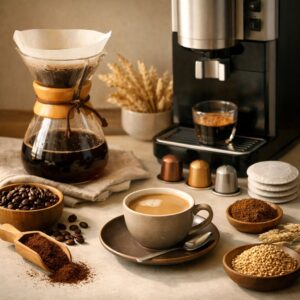
German coffee culture at home: coffee machines, filter coffee, beans, capsules, and pads in a modern kitchen setting.
What makes German coffee culture so interesting is its range. It stretches from classic filter coffee to fully automatic machines, from ground coffee to beans, from coffee pads to capsules. Some households still prefer the straightforward comfort of a pot of filter coffee, while others have embraced convenience, precision, or a more café-like experience at home. And then there is the quieter, more nostalgic side of the story: coffee substitutes such as Caro Landkaffee and Im Nu coffee, which still occupy a place in German memory and, in some homes, on the pantry shelf.
This is not a culture defined by one brewing method or one fixed idea of how coffee should taste. It is shaped by habit, practicality, taste, and memory. In that sense, coffee in Germany says a great deal about everyday life itself: how people live, what they value, and how tradition and modern convenience continue to coexist.
Coffee has a special kind of ordinariness in Germany. It is rarely presented as a ritual in the grand sense, yet it often marks the most important moments of the day. A first cup in the morning can set the tone for everything that follows. A second cup in the afternoon can turn a short pause into a proper break. A cup offered to a guest can say welcome without needing many words.
That is one reason coffee feels so deeply embedded in German life. It is flexible enough to fit different routines, but familiar enough to feel stable. Some people drink it quickly before leaving the house. Others sit down with it properly, especially on weekends or when family and friends are around. The form changes, but the role remains the same.
Coffee also has a social function that should not be underestimated. It is tied to conversation, hospitality, and the small rituals that make a home feel lived in. Coffee and cake remains one of the most recognizable combinations in German domestic culture, and even when the setting is informal, coffee still tends to signal a moment of pause and attention.
One of the defining features of coffee culture in Germany is the way older habits have survived alongside newer ones. Filter coffee has never really disappeared. At the same time, fully automatic machines, capsule systems, and coffee pads have become normal in many households. The result is not a replacement of one culture by another, but a layering of habits.
That layering matters. It means there is no single German coffee household. One kitchen may still rely on a simple filter machine and ground coffee. Another may use beans and a fully automatic machine. A third may keep capsules for weekdays and a more traditional setup for weekends. Coffee culture in Germany is practical in that sense: people choose what works for their routine, not what fits a theory.
This is also why coffee remains such a revealing household product. It reflects how people balance time, taste, cost, and convenience. Some want the easiest possible cup. Others want freshness and control. Many want both, depending on the day.
If there is one format that still feels unmistakably rooted in German home life, it is filter coffee. It is simple, familiar, and remarkably durable. For generations, it has been the everyday standard in many households, and it still carries that role today.
Filter coffee has a certain honesty to it. It does not ask for much. It is easy to prepare, easy to serve, and easy to make in larger quantities. That makes it especially practical for families, guests, and anyone who prefers a straightforward cup without extra steps or equipment.
There is also something reassuring about its consistency. Filter coffee does not need to be trendy to remain relevant. It is the kind of drink that quietly endures because it fits real life. In a market full of machines, pods, and premium brewing systems, that simplicity still has value.
If filter coffee represents continuity, coffee machines represent adaptation. Over the past years, the German kitchen has become increasingly shaped by convenience and precision. Standard drip machines, bean-to-cup systems, and fully automatic machines have all found a strong place in everyday use.
The appeal is easy to understand. Coffee machines save time, reduce effort, and deliver a predictable result. For busy households, that reliability matters. For people who want a better-tasting cup without having to think too much about the process, it matters even more.
Fully automatic machines, in particular, have become associated with a more premium home coffee experience. They allow households to use beans, adjust strength, and prepare a range of drinks with little effort. They are part of a broader shift in which coffee at home is no longer just about function. It is also about quality, texture, and a sense of everyday comfort.
Coffee preferences in Germany are shaped as much by practicality as by taste. The format people choose often depends on how they live, how much time they have, and how much importance they place on freshness or convenience.
Ground coffee remains one of the most common household formats. It is familiar, affordable, and easy to use. For many people, it is still the most natural choice for filter coffee and a dependable everyday option.
Beans are often associated with freshness and a more considered coffee routine. They require a grinder or a bean-to-cup machine, but they reward that extra effort with aroma and control. Households that choose beans usually do so because taste matters enough to justify the added step.
Instant coffee has its own place in German households, especially where speed, simplicity, and storage convenience matter most. Freeze-dried soluble coffee is easy to prepare, keeps well, and remains a practical option for busy mornings, small kitchens, travel, or anyone who wants a quick cup without a machine. It may not carry the same ritual feel as filter coffee or beans, but it remains a reliable everyday format.
Capsules have become a major convenience format in German homes. Their appeal lies in speed and simplicity. They are easy to store, easy to use, and consistent from cup to cup. For smaller households or busy mornings, that convenience can be decisive.
Coffee pads sit somewhere between traditional brewing and modern convenience. They are quick, tidy, and familiar, which makes them attractive to households that want a simple cup without moving fully into capsule systems.
Coffee balls are a newer convenience format that fits neatly into the same everyday logic. They are designed for quick preparation and easy handling, making them another option for households that value simplicity and a modern coffee routine. As with capsules and pads, their appeal lies less in ceremony than in ease of use.
The format a household uses is often less about ideology than routine. Larger households may prefer filter coffee because it is efficient. Smaller households may lean toward capsules because they are quick. Coffee enthusiasts may choose beans because they want more control. Many homes use more than one format depending on the situation.
How coffee is served matters just as much as how it is brewed. In Germany, the final cup is often shaped by habit rather than rules.
Some people drink coffee black and prefer it that way. Others add milk for softness and a smoother taste. Sugar remains a personal choice, neither universal nor unusual. The point is not that one version is more authentic than another. The point is that coffee habits in Germany are deeply individual, even when they are shared across generations.
That flexibility is part of coffee’s strength. It can be plain, milky, sweetened, or somewhere in between. It can be made quickly or carefully. It can be a habit, a comfort, or a small daily pleasure.
At home, coffee is rarely just a beverage. It is part of the rhythm of the day.
In the morning, it helps mark the transition from sleep to activity. In the afternoon, it creates a pause. In the evening, for some households, it may still appear as part of a visit or a quiet moment with family. The drink itself may be simple, but the role it plays is not.
Coffee also has a strong place in hospitality. Offering coffee is one of the most ordinary ways to make someone feel welcome. It is a gesture that does not need explanation. In that sense, coffee is part of the social language of the home.
Few combinations are as closely associated with German home life as coffee and cake. It is not just a snack. It is a ritual, a pause, and often a social occasion.
The pairing works because it is both relaxed and structured. It creates a moment that feels special without becoming formal. It is the kind of tradition that can survive changing tastes because it is built around atmosphere as much as food or drink.
Even in households where daily coffee has become highly modernized, the coffee-and-cake moment often remains recognizably traditional. It is one of the clearest examples of how German coffee culture holds on to continuity while still adapting to new habits.
Coffee substitutes are not the main story of coffee culture in Germany, but they are part of it. They matter because they show how people have long looked for alternatives that fit different needs, tastes, and historical circumstances.
Caro Landkaffee has a long-standing presence in German households. It is made from roasted barley, malted barley, chicory, and rye, and it is caffeine-free. That combination gives it a mild, grainy, roasted character that has made it a familiar alternative for generations.
Caro was developed in 1954, in a period when post-war coffee shortages and high prices still shaped everyday consumption. In that context, grain-based coffee substitutes were not just a matter of taste. They were practical, accessible, and easy to integrate into family life. Because Caro is caffeine-free, it also became a natural choice for children, older people, and anyone who wanted a warm drink without stimulation.
Im Nu coffee played a major role in the GDR and remains available today. It belongs to a different historical context, but it shares the same broad logic: a coffee-like drink without caffeine, rooted in everyday domestic use. For many people, it carries a strong nostalgic association and remains part of East German memory.
After the Second World War, coffee substitutes became popular because real coffee was expensive, limited, or difficult to obtain. Grain-based drinks offered a practical solution at a time when households needed affordable, accessible alternatives. They were easy to store, easy to prepare, and suitable for the whole family.
That family appeal mattered. Because these drinks were caffeine-free, they could be served to children and enjoyed by older people as well. They were not only substitutes in the narrow sense. They were part of a broader domestic culture of comfort and continuity.
The story of coffee substitutes in East Germany is not only about scarcity or practicality. It is also about continuity. Products like Im Nu coffee became part of everyday life in a way that still shapes memory today.
That kind of cultural persistence matters. It shows how a household product can become part of a wider social experience. Even now, these names can evoke a very specific domestic world — one shaped by routine, adaptation, and familiarity.
At the same time, the fact that these products are still available means they have not been reduced to nostalgia alone. They remain usable, recognizable, and present in the market. That gives them a living role rather than a purely historical one.
Coffee is easy to buy in Germany, but the way people shop for it reveals a lot about their priorities.
Most households buy coffee in supermarkets or discounters. That is where convenience, price, and familiarity meet. For everyday use, these channels remain the most important.
For beans, machines, and accessories, specialty stores and online shops play a bigger role. They offer more choice and often more detailed product information. That matters for shoppers who care about taste or equipment.
When buying coffee, people often compare price, roast, origin, format, convenience, and sustainability. The decision is rarely based on just one factor. It is usually a balance between what tastes good, what is practical, and what fits the household budget.
| Product type | Typical use |
|---|---|
| Ground coffee | Everyday brewing, filter coffee |
| Coffee beans | Freshness, home grinding, premium use |
| Instant coffee | Fast preparation, travel, small kitchens |
| Capsules | Speed, convenience, consistency |
| Pads | Simple preparation, familiar taste |
| Coffee balls | Quick preparation, modern convenience |
| Coffee substitutes | Caffeine-free or nostalgic alternatives |
Yes. Filter coffee remains one of the most familiar and widely used coffee formats in German households.
All three are common, but ground coffee and convenience formats such as capsules and pads remain especially important in everyday use.
It is not the standard household coffee, but it is part of the broader coffee culture, especially in multicultural settings and urban areas.
Both are convenience formats, but pads are often seen as closer to traditional coffee, while capsules are usually associated with speed and variety.
Caro Landkaffee and Im Nu coffee are among the best-known names.
Because it fits naturally into the rhythm of the day — at home, at work, with guests, and during breaks.
Coffee culture in Germany is broad, practical, and quietly expressive. It brings together old habits and new technologies, everyday routines and small moments of hospitality, familiar taste and changing preferences. Some households still rely on filter coffee. Others prefer beans, capsules, or pads. Some drink coffee black, while others add milk or sugar. And alongside all of that, coffee substitutes such as Caro Landkaffee and Im Nu coffee still hold a place in the background, carrying both usefulness and memory.
That mix is what makes German coffee culture so interesting. It is not a single tradition frozen in time. It is a living part of everyday life — one that continues to adapt without losing its sense of familiarity.

