
24
Apr
Leipzig stands as the largest city in Saxony and is second only to Berlin among the urban centers of Eastern Germany. Located at the crossroads of trade routes, it has evolved into a prominent economic powerhouse, cultural beacon, and historical landmark. This guide delves into Leipzig’s origins, its rise as a trade and cultural hub, the significance of iconic sites like the Höfe am Brühl and Leipzig Hauptbahnhof, and the city’s culinary delights that capture the essence of Saxon tradition.
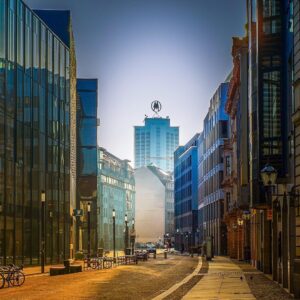
Leipzig’s cityscape blends modern glass facades with historic architecture, crowned by the Wintergartenhochhaus and its iconic rotating “MM” sign.
First mentioned in records in 1015, Leipzig’s name derives from the Slavic word ‘Lipzk,’ meaning ‘place of linden trees.’ In 1165, it received city rights from Otto the Rich, marking the beginning of its urban development. Over the centuries, Leipzig grew into a medieval trade center, especially after the granting of the privilege to hold a major fair in 1497. This fair tradition persists today at the Leipzig Trade Fair, one of Europe’s oldest and most influential. Leipzig’s prominence in the German Empire continued through the 19th century, fueled by publishing, musical patronage, and burgeoning industries.
In the 20th century, Leipzig experienced both turmoil and transformation. Under the GDR, it remained an industrial hub yet preserved much of its architectural heritage. The Peaceful Revolution of 1989 saw mass protests in Leipzig, setting in motion the end of socialist rule in East Germany. Since reunification in 1990, Leipzig has rebounded spectacularly, attracting new businesses, creative talents, and investors. Today, it anchors the Central German Metropolitan Region, linking Berlin, Dresden, and other major cities via extensive rail and road networks.
Leipzig’s urban tapestry weaves Gothic churches, Baroque palaces, and modernist structures. The imposing St. Thomas Church, where J.S. Bach served as cantor, remains a pilgrimage site for music lovers. The Old Town Hall, dating back to 1556, houses the city museum and stands on the historic market square. Contemporary art thrives in the Spinnerei galleries, set in a former cotton mill in Plagwitz, underscoring Leipzig’s designation as Germany’s ‘Hottest Creative City.’
Among these landmarks, two stand out for their blend of history and modern use: the Höfe am Brühl and Leipzig Hauptbahnhof.
The Bruehl, first mentioned in 1352, was originally a bustling street lined with merchants’ stalls and artisan workshops. Over time, it became synonymous with city trade. In the 1970s, the GDR replaced the medieval fabric with a stark, prefabricated retail block known colloquially as the ‘Blechbüchse’ (tin can). While practical, it lacked the charm of its predecessors.
After German reunification, plans emerged to reimagine the site. Demolition of the Blechbüchse began in 2003, making way for a sustainable, glass-clad complex that harmonized with nearby historical facades. Opened in October 2011, the Hoefe am Bruehl comprises five interconnected courtyards, over 40 shops, cafes, and restaurants. Its design integrates public art and green roofs, reconnecting the space with Leipzig’s pedestrian-friendly ethos. The Hoefe am Bruehl now stands as a testament to adaptive urban regeneration.
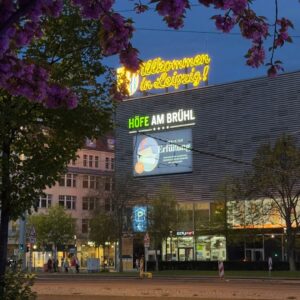
The vibrant neon sign “Willkommen in Leipzig” greets visitors above the Hoefe am Bruehl shopping mall in Leipzig’s city center, framed by blooming cherry trees.
Leipzig Hauptbahnhof (Leipzig Central Station) began operation in 1915, replacing earlier stations that could no longer handle increasing rail traffic. Designed by architect William Lossow, it spans 83,460 square meters, making it the largest terminal station by floor area in Europe. With 24 platforms, it connects Leipzig to major German cities and international destinations.
After falling into disrepair in the late 20th century, the station underwent an extensive restoration from 1997 to 1999. The overhaul introduced a spacious shopping arcade, newsstands, and dining options, transforming the Hauptbahnhof into both a transportation hub and a vibrant commercial center. Daily, more than 120,000 travelers and visitors pass through its halls, marveling at the blend of historic elegance and modern amenities.

A striking black and red steam locomotive stands proudly at the platform of Leipzig Hauptbahnhof (Central Station), one of Europe’s largest railway stations.
As part of the Metropolregion Mitteldeutschland, Leipzig hosts over 25,000 companies, including automaker BMW and global publishers like Leipziger Verlag. Its universities and research institutes fuel innovation in biotechnology, information technology, and logistics. The Port of Leipzig, one of Germany’s largest inland ports, and the Leipzig/Halle Airport underpin its reputation as a logistics powerhouse.
Leipzig’s central location—250 miles (400 km) southeast of Berlin and 130 miles (210 km) northwest of Prague—ensures excellent connectivity. An extensive tram and bus network complements the Hauptbahnhof. High-speed Intercity-Express (ICE) trains link Leipzig to Frankfurt and Munich in under three hours, while regional trains serve smaller Saxon towns. This transport matrix supports daily commuters, tourists, and cargo alike.
Among these, the most iconic is Leipziger Allerlei, a medley of peas, carrots, asparagus, morels, and often crayfish, traditionally served with a light butter or crayfish sauce. First documented in the 18th century, it celebrated the spring harvest and the Leipzig fair season.
Another regional favorite is Quarkkeulchen, small pancakes made from farmer’s quark cheese, eggs, flour, and mashed potatoes. Fried until golden, they come sprinkled with sugar and accompany fruit compote. In restaurants, visitors savor hearty Sauerbraten (marinated pot roast) with red cabbage and potato dumplings. Local brewers craft wheat beers and pilsners that pair perfectly with sausages and pretzels.
Private kitchens continue these traditions. Generations pass down recipes for Mettwurst and freshly baked bread from wood-fired ovens. Family gatherings feature homemade Apfelstrudel dusted with powdered sugar and served warm with vanilla ice cream.
A colorful vegetable and crayfish medley from Leipzig, celebrating Saxony’s springtime harvest.
Serves: 4
300 g (10.6 oz) fresh green peas
200 g (7.1 oz) carrots, diced
150 g (5.3 oz) green asparagus tips
100 g (3.5 oz) cooked crayfish tails (or shrimp as a substitute)
50 g (1.8 oz) unsalted butter
2 tbsp (30 ml) all-purpose flour
250 ml (8.5 fl oz) whole milk
100 ml (3.4 fl oz) vegetable broth
Salt and freshly ground black pepper, to taste
Blanch the vegetables: Bring a pot of salted water to a boil. Add the peas, carrots, and asparagus. Blanch for 3 minutes, then drain and set aside.
Make the sauce: In a medium saucepan, melt the butter over medium heat. Stir in the flour and cook for 1–2 minutes, stirring constantly to create a light roux. Gradually whisk in the milk and vegetable broth until the sauce is smooth.
Season and combine: Season the sauce with salt and pepper. Gently fold in the blanched vegetables and crayfish tails. Simmer over low heat for about 5 minutes, stirring occasionally.
Serve hot: Plate immediately while warm. Optionally, pair with Semmelklöße (bread dumplings) or boiled potatoes for a more filling meal.
Enjoy a true taste of Leipzig’s fair season—a recipe that once nourished merchants and locals in Saxony’s capital during the bustling trade fairs of the 18th century.
Uwe, a graphic designer who grew up near the Brühl, fondly recalls visiting the old Blechbüchse (a once-iconic landmark) as a child in the 1980s. He was captivated by its futuristic metal facade, even though it felt somewhat out of place amid the city’s traditional stone buildings. Today, he brings his own children to the Hoefe am Bruehl, marveling at how the courtyards blend the city’s medieval roots with its modern, vibrant flair. For Uwe, Leipzig is more than just a city—it’s a living narrative of transformation and reinvention.
Leipzig’s blend of history, culture, and innovation makes it a must-visit city in Eastern Germany. From its medieval fairs to modern art galleries, and from hearty regional cuisine to Europe’s largest terminus station, it offers an experience unlike any other. Whether you’re a tourist, historian, foodie, or daily commuter, Leipzig welcomes you with open courtyards and vibrant streets.
Plan your visit, savor the flavors, and immerse yourself in a metropolis that continues to write its story—one brick, one recipe, and one melody at a time.
Leipzig is officially the largest city in Saxony and ranks second in size among Eastern German cities. Its population, economic output, and cultural institutions qualify it as a true metropolis.
Leipzig is known as the “City of Music” and the “Boomtown of the East,” reflecting its musical heritage and dynamic post-reunification growth.
Yes. From 1949 to 1990, Leipzig was part of the German Democratic Republic and played a key role in the Peaceful Revolution of 1989.
Leipzig combines centuries-old architecture with modern art spaces, hosts one of Europe’s oldest trade fairs, and fosters a thriving startup scene.
Leipzig Hauptbahnhof, opened in 1915, spans 83,460 m² and offers 24 platforms, making it Europe’s largest terminus railway station by area.
The Bruehl dates back to medieval Leipzig (documented in 1352). The modern Hoefe am Bruehl shopping center opened in October 2011 after replacing the 1975 “Blechbüchse.”

