
13
Apr
Oktoberfest Munich 2026 will take place from September 19 to October 4, 2026, on the Theresienwiese in Munich, Germany. The festival is more than a seasonal event. It is the latest chapter in a story that began in 1810 and grew from a royal wedding celebration into the world’s largest folk festival. For visitors, that history is not just background. It is the reason the event still feels distinctive, rooted, and unmistakably tied to Munich.
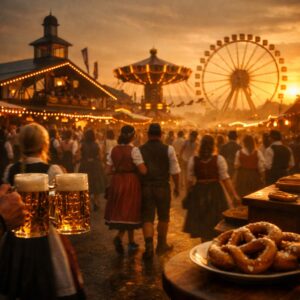
Oktoberfest Munich 2026 brings Bavarian tradition, the Theresienwiese, and more than 200 years of festival history into one iconic event.
The first Oktoberfest took place on October 17, 1810, when Crown Prince Ludwig of Bavaria married Princess Therese of Saxony-Hildburghausen. The citizens of Munich were invited to join the festivities, which were held on a meadow outside the city gates. That meadow later became known as the Theresienwiese, the site where Oktoberfest still takes place today.
The original celebration included a horse race, and that race became the symbolic starting point of the festival tradition. What began as a one-time event quickly proved popular enough to return. Over time, the annual celebration expanded beyond its royal origins and became a public festival with a life of its own.
In its early decades, Oktoberfest was still closely tied to the monarchy and local civic life. The event gradually grew in scale, adding more attractions, more visitors, and more of the elements people now associate with the festival: food, music, rides, and large gathering tents.
A major turning point came in 1872, when the festival was moved into September to make use of the better weather at the end of summer. That decision shaped the modern version of Oktoberfest. Even though the name remained the same, the timing changed, and the festival became a late-summer and early-autumn tradition rather than a strictly October event.
The Theresienwiese is not just the location of Oktoberfest. It is part of the festival’s identity. Named after Princess Therese, the site connects the present-day event to its 19th-century origins. For more than two centuries, the same grounds have hosted the festival, giving Oktoberfest a sense of continuity that few major public events can match.
That historical setting helps explain why Oktoberfest feels different from a typical fair or food festival. It is deeply tied to place. The grounds, the ceremonies, and the repeated rituals all reinforce the idea that visitors are taking part in something that has been passed down, not invented anew each year.
What makes Oktoberfest remarkable is the way it moved from local celebration to international symbol. Munich’s festival became known far beyond Bavaria because it combined clear tradition with open public participation. Visitors did not need to be part of the original royal event to feel included in the festival itself.
As the years passed, Oktoberfest developed into a large-scale public gathering with beer tents, music, food, and fairground attractions. Its popularity grew steadily, and so did its reputation. Today, people travel from around the world to Munich to experience a festival that still carries traces of its origins while functioning as a modern urban event.
Several traditions link the present-day Oktoberfest to its past. The ceremonial tapping of the first keg remains one of the most recognizable moments of the festival. The Oide Wiesn, the historic section of Oktoberfest, also reflects the event’s older character by preserving a more traditional atmosphere.
These elements matter because they keep the historical narrative visible. Oktoberfest is not only about entertainment. It is also about memory, ritual, and continuity. Visitors who understand the history are more likely to see the festival as more than a party. They see it as a living tradition.
The 2026 edition will take place from September 19 to October 4 on the Theresienwiese in Munich. In historical terms, that means another chapter in a tradition that has already lasted more than 200 years. The date, the place, and the rituals all connect the modern festival to the original celebration of 1810.
For travelers, that historical depth is part of the appeal. Oktoberfest Munich 2026 is not simply a date on the calendar. It is an opportunity to experience a festival that has survived political change, cultural shifts, and changing tastes while still keeping its core identity intact.
The history of Oktoberfest gives the festival meaning. Without it, the event would be just another large public gathering. With it, Oktoberfest becomes a cultural landmark. The royal wedding, the horse race, the move to September, and the continued use of the Theresienwiese all help explain why the festival remains so recognizable.
That is why history is central to any discussion of Oktoberfest Munich 2026. The festival’s present cannot be separated from its past. Every tent, every ritual, and every crowd on the Theresienwiese is part of a tradition that began in 1810 and continues to evolve today.
Oktoberfest Munich 2026 is best understood through its history. It began as a royal celebration, grew into a civic tradition, and became a global festival without losing its connection to Munich. The Theresienwiese, the opening ritual, and the historic atmosphere all reflect that long development. For anyone asking what Oktoberfest really is, the answer lies in its past as much as in its present.

