
25
Sep
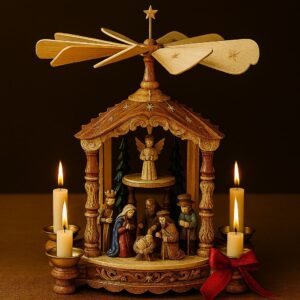
A beautifully carved German Christmas pyramid from the Erzgebirge region, showcasing the nativity scene in warm candlelight and timeless craftsmanship.
A German Christmas pyramid is more than a decoration — it’s a living piece of European folk craft that brings motion and story to holiday décor. From modest tabletop pieces to large multi-tiered centerpieces, these wooden pyramids are prized for their quiet rotation, detailed carving, and warm candlelight. This guide explains their origins in the Erzgebirge region, how they work, how to choose authentic pieces, care and safety best practices, buying tips for shoppers in the USA and Canada, and answers to the long-tail questions buyers commonly type into search engines.
A Weihnachtspyramide, or Christmas pyramid, typically consists of:
The result is a slow, mesmerizing carousel of figures — a mechanical tabletop theater powered by heat and craftsmanship.
The Christmas pyramid tradition grew from the woodcraft culture of the Erzgebirge in Saxony, Germany. Mining shaped life there for centuries; when miners and their families carved toys and devotional objects during the long winters, layered wooden displays and candle-driven motion became local hallmarks. Over time these pragmatic local crafts evolved into the stylized pyramids we know today — a fusion of folk art, miner motifs, and festive storytelling.
The mechanism relies on simple convection physics:
Because movement depends on gentle convection rather than electricity, the motion is quiet and graceful — a key part of the pyramid’s charm.
Christmas pyramids come in a wide range of sizes and styles:
When choosing a pyramid, measure the display area and consider ceiling height for larger models. Also think about transportation: large Erzgebirge originals are heavy and may incur significant shipping or import costs.
To preserve value and get the mechanics and finish you expect, watch for these markers of authenticity:
If authenticity matters — for display, heirloom value, or gifting — purchase from trusted dealers who provide provenance or certification.
To keep a wooden pyramid beautiful and functional for decades:
Proper care preserves both the visual charm and monetary value of handcrafted pyramids.
Disclaimer: This article provides practical safety suggestions but is not a substitute for professional fire-safety advice or local regulations. Always comply with applicable laws and manufacturer warnings.
Traditional pyramids range from simple one-tier models to elaborate multi-tier carousels. Common scenes include:
Tiers tell a visual story; artisans place simpler scenes on lower tiers and more symbolic figures near the top.
It’s called a Weihnachtspyramide in German and commonly referred to in English as a German Christmas pyramid or Christmas pyramid.
Tealights or candles heat the air; that rising warm air turns the angled blades of the rotor, rotating the tiers slowly and evenly.
Specialist importers and retailers focusing on German Christmas traditions are your best source. In our Christmas Shop, we offer a curated selection of traditional seasonal items — including authentic Erzgebirge pyramids. These handcrafted pieces tend to sell out quickly, based on past experience. If you’re still looking for a specific model, feel free to reach out to us via our contact form — we’re happy to help!
Yes. LED tealights are recommended for households with children or pets, or where constant supervision of open flames is impractical. They preserve the visual effect while removing fire hazards.
Two to four tiers are common for traditional tabletop models; larger exhibition pyramids feature many more tiers depending on artisan design.
High-quality local woods, hand carving, smooth mechanical action, and provenance or maker marks indicating origin in the Erzgebirge region.
Store in a dry, temperature-stable place, dust with a soft brush, avoid water and harsh cleaners, and handle with care.
🔥 Additional Note on German Candle Traditions: Traditional Christmas pyramids and the German Advent wreath often use real candles. Always supervise open flames, keep decorations away from flammable materials, and never leave candles burning unattended. If safety is a concern, consider using LED tealights for a flame-free alternative that still captures the warm, festive glow.
While the German Christmas pyramid is a moving centerpiece often powered by real candles, it’s just one of many beautiful German candle traditions. Another iconic example is the German Advent wreath with four candles, symbolizing the countdown to Christmas — a ritual found in homes across Germany and now popular worldwide.

